
Click and drag the image to zoom and explore.
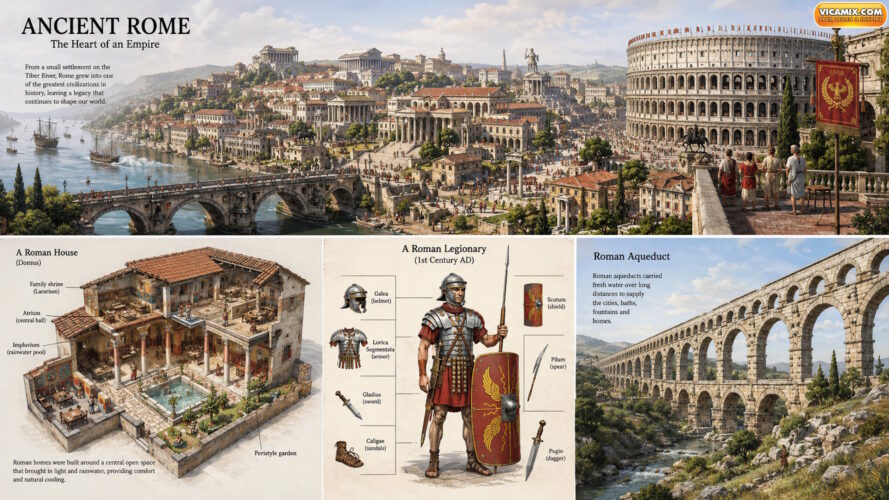
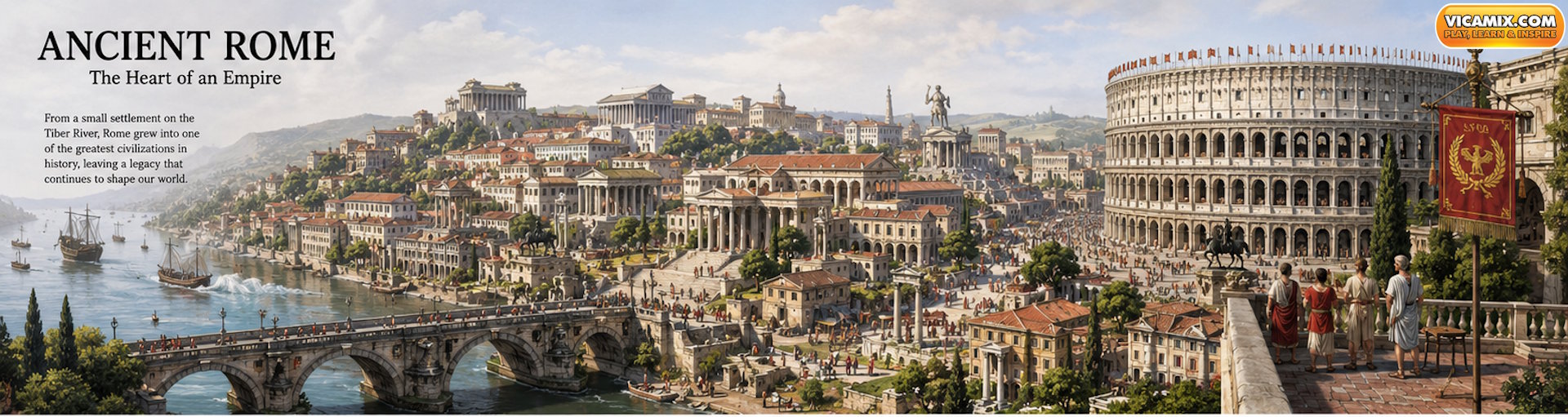
Roman civilization was one of the greatest and most influential civilizations in human history. From a small settlement on the Italian Peninsula, Rome grew into a vast empire that stretched across Europe, North Africa, and the Middle East. Its achievements in government, engineering, architecture, law, literature, and military organization shaped the development of Western civilization and continue to influence the modern world.
The Origins of Rome
According to Roman legend, the city of Rome was founded in 753 BC by the twin brothers Romulus and Remus, who were raised by a she-wolf. While this story is mythical, archaeological evidence suggests that Rome gradually developed from small farming communities along the Tiber River.
Rome was initially ruled by kings before becoming a republic in 509 BC. During the Roman Republic, elected officials and the Senate governed the state. Although political power was largely held by wealthy families, the republic introduced ideas about citizenship, public service, and representative government that would inspire future political systems.
The Expansion of the Roman Republic
Click and drag the image to zoom and explore.
Over several centuries, Rome expanded through military strength, strategic alliances, and effective administration. The Romans gradually conquered the Italian Peninsula before defeating powerful rivals such as Carthage during the Punic Wars. These victories transformed Rome into the dominant power of the Mediterranean.
As Roman territory grew, so did its wealth and influence. Trade flourished across the empire, bringing valuable goods, new technologies, and cultural ideas from distant lands.
The Roman Empire
Click and drag the image to zoom and explore.
Political instability eventually led to the end of the Republic. In 27 BC, Octavian became the first Roman emperor, taking the title Augustus. His reign marked the beginning of the Roman Empire and a long period of relative peace known as the Pax Romana, or “Roman Peace.”
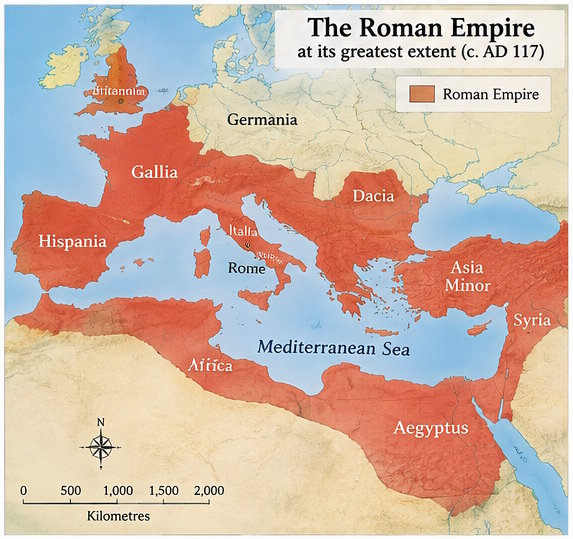
During this era, cities expanded, roads connected distant provinces, and trade reached unprecedented levels. At its greatest extent under Emperor Trajan in the second century AD, the Roman Empire controlled millions of people across three continents.
Engineering and Architecture
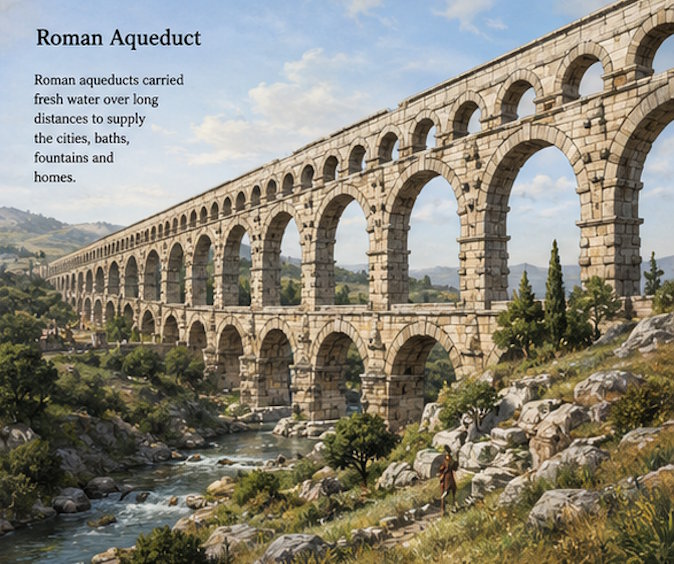
Click and drag the image to zoom and explore.
The Romans were exceptional engineers and builders. They developed durable concrete, allowing them to construct impressive structures that have survived for thousands of years. Their achievements included aqueducts that transported fresh water over great distances, extensive road networks, public baths, bridges, temples, amphitheaters, and massive arenas.
The Colosseum in Rome remains one of the world’s most recognizable ancient monuments. Roman roads, many of which are still visible today, enabled efficient travel, communication, and military movement throughout the empire.
Law and Government
One of Rome’s greatest contributions was its legal system. Roman law emphasized written rules, legal procedures, contracts, and the protection of property. Many legal principles developed by the Romans became the foundation of modern legal systems in Europe and beyond.
The Roman model of citizenship also evolved over time. Eventually, citizenship was extended to nearly all free inhabitants of the empire, helping unify its diverse population.
Daily Life in Ancient Rome
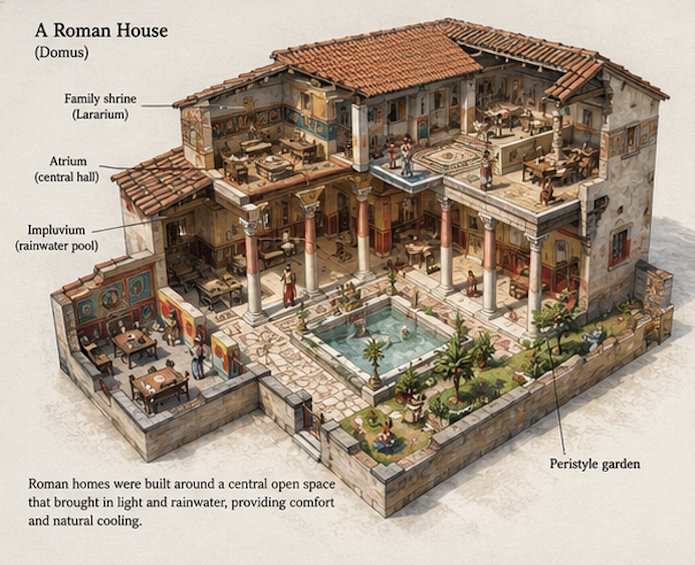
Click and drag the image to zoom and explore.
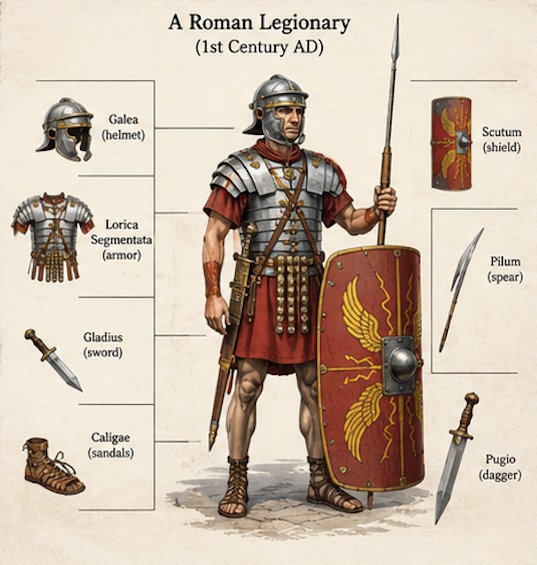
Roman society included wealthy nobles, merchants, soldiers, artisans, farmers, and enslaved people. Large cities featured marketplaces, public baths, temples, theaters, and forums where people gathered for business and political discussions.
Education focused on reading, writing, rhetoric, and philosophy, particularly for the upper classes. Latin became the dominant language throughout much of the empire and later evolved into the Romance languages, including Italian, French, Spanish, Portuguese, and Romanian.
The Decline of the Empire
From the third century AD onward, the Roman Empire faced increasing challenges, including political instability, economic difficulties, military conflicts, and invasions by various tribes. In AD 395, the empire was permanently divided into the Western and Eastern Roman Empires.
The Western Roman Empire officially fell in AD 476, while the Eastern Roman Empire, often called the Byzantine Empire, continued for nearly another thousand years until the fall of Constantinople in 1453.
The Lasting Legacy of Rome
The influence of Roman civilization extends far beyond antiquity. Modern governments, legal systems, architecture, engineering, urban planning, languages, and educational traditions all bear the mark of Rome’s achievements.
Roman arches, domes, and columns continue to inspire architects around the world. Latin remains widely used in scientific terminology, medicine, biology, and law. The Roman calendar also served as the foundation for the modern calendar used today .
Although the Roman Empire disappeared centuries ago, its ideas and innovations remain deeply embedded in modern society. The civilization of ancient Rome stands as a remarkable example of how one culture can shape the course of world history for generations to come.
RELATED CONTENT & ACTIVITIES:
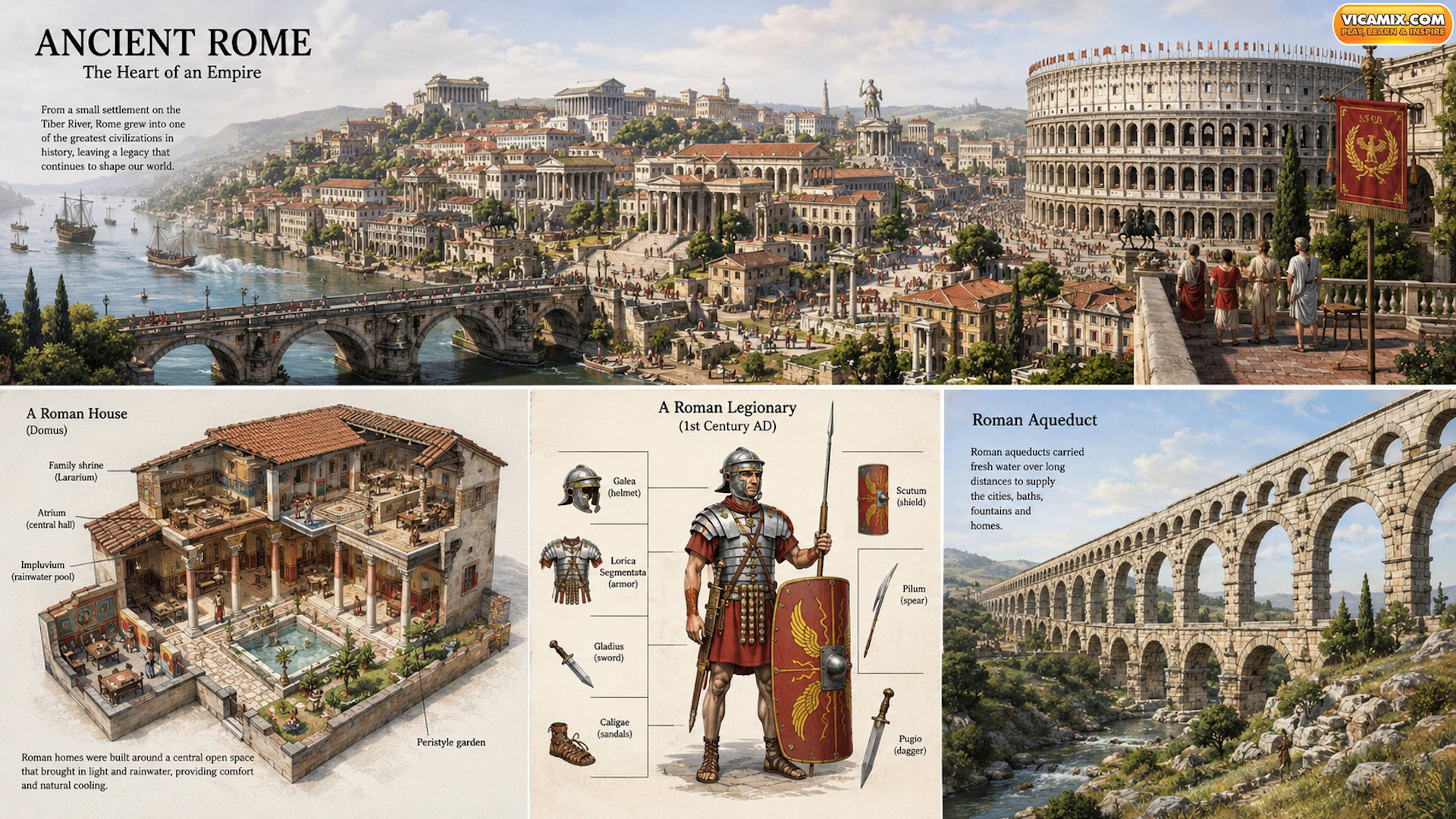
FREE DESKTOP WALLPAPER
Click the image, save it to your computer or tablet and use it as your desktop wallpaper 🙂
*****
GAME:
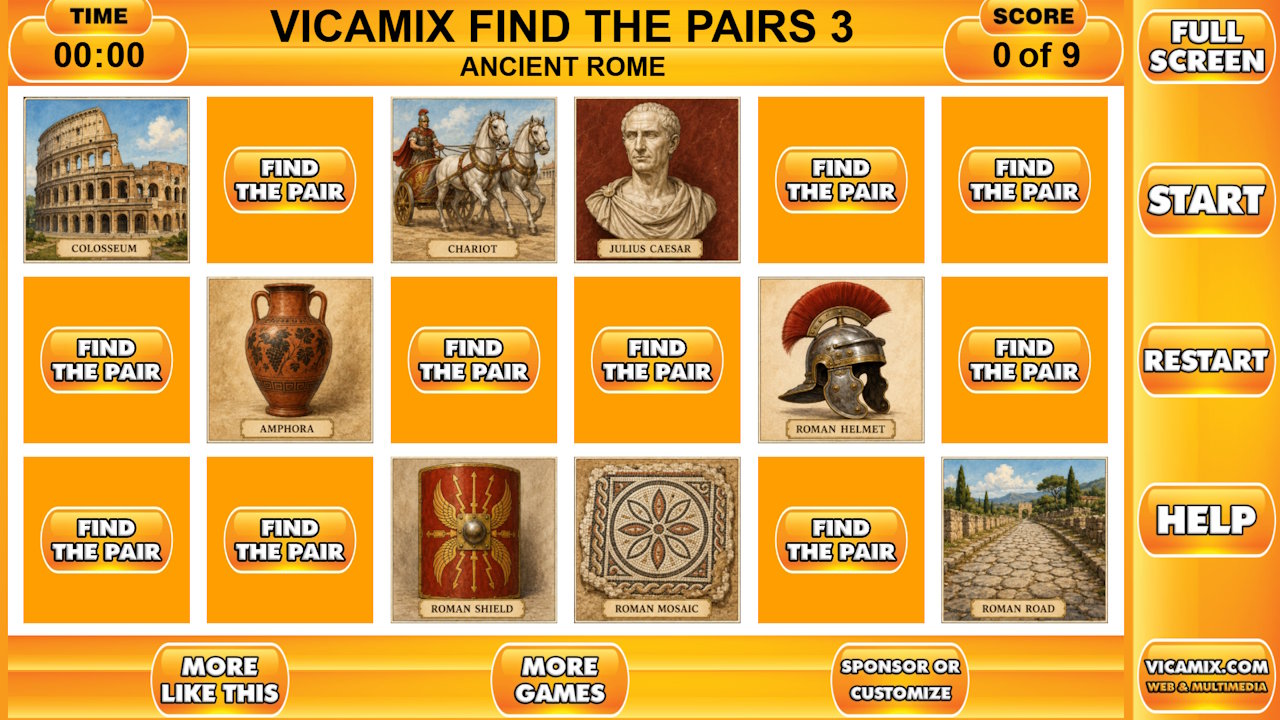
Find The Pairs 3 – Ancient Rome – Browser Game
LEARN MORE
Some related videos on YouTube:
Related subjects: Roman Civilization, Ancient Rome, Roman Empire, Roman Republic, Pax Romana, Roman Law, Roman Architecture, Roman Engineering, Latin, Ancient History








Add comment