
Click any image to enlarge it or save it.
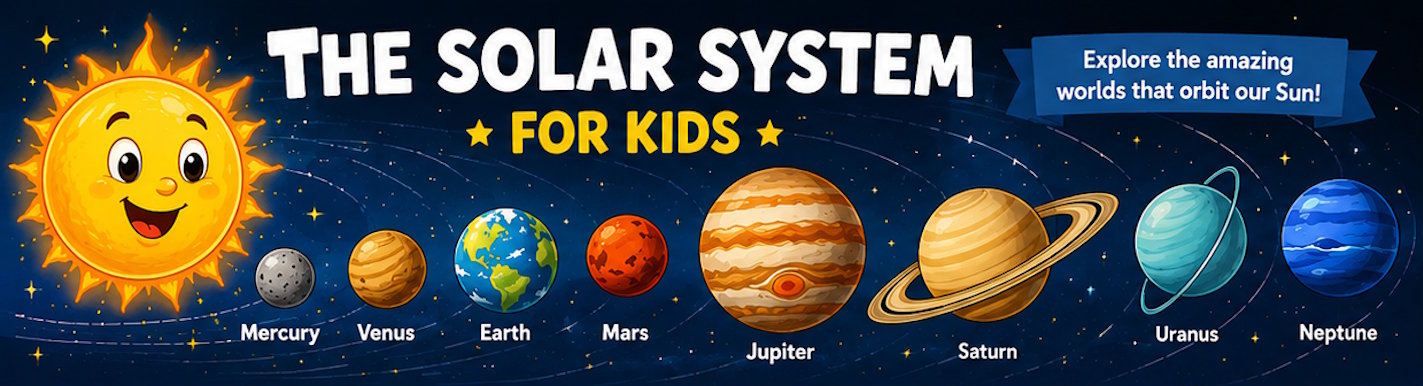
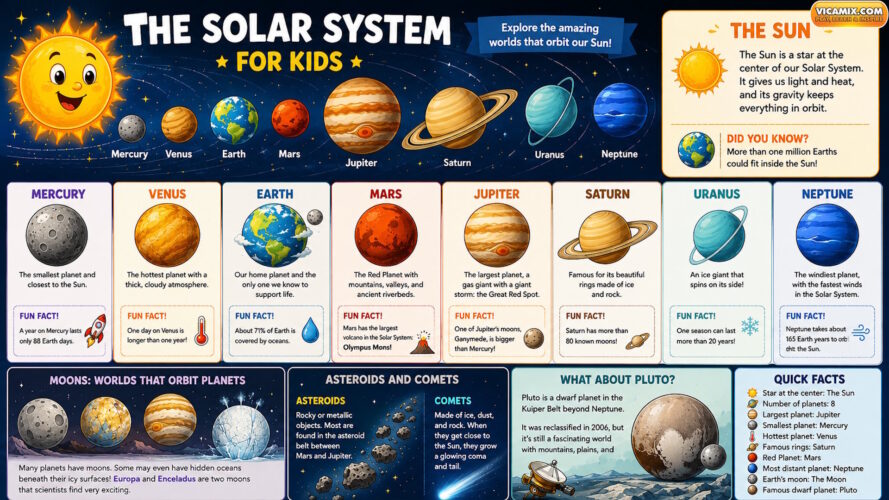
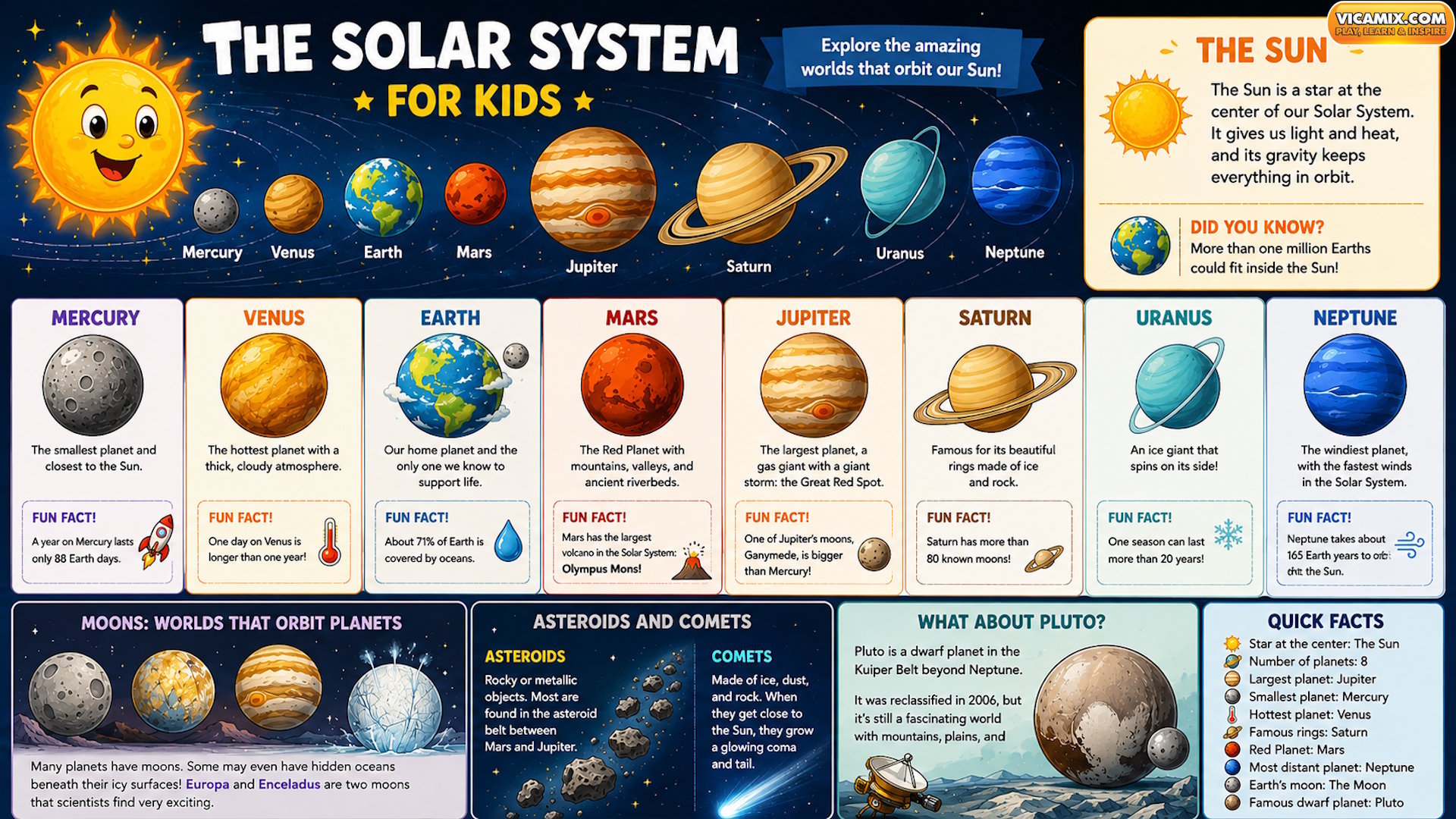
Our Solar System is made up of the Sun and everything that travels around it. This includes eight planets, moons, dwarf planets, asteroids, comets, and countless smaller objects.
Let’s take a journey from the Sun to the distant edges of our cosmic neighborhood!
☀️ The Sun: The Heart of the Solar System
The Sun is a star, just like the stars we see in the night sky. The difference is that the Sun is much, much closer to Earth.
It is a gigantic ball of extremely hot gas, mostly hydrogen and helium. The Sun provides the light and heat that make life on Earth possible.
The Sun is also the most massive object in our Solar System. Its gravity keeps the planets and many other objects moving around it.
Did you know? The Sun is so large that more than one million Earths could fit inside it!
🌍 The Eight Planets
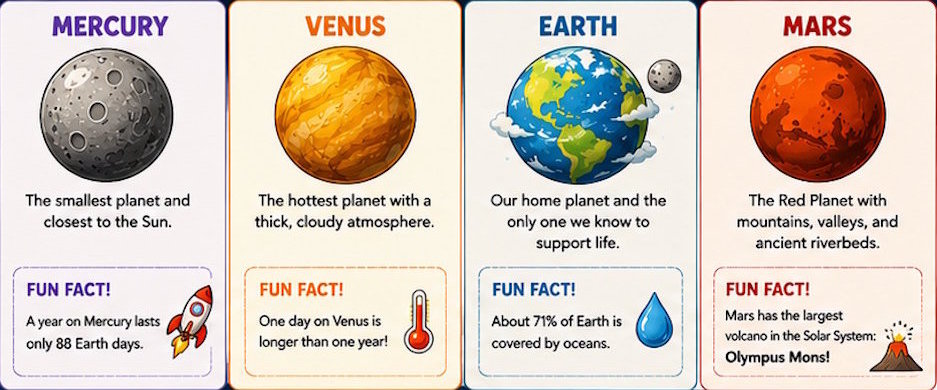
There are eight officially recognized planets in our Solar System. They can be divided into two main groups: the rocky planets and the giant planets.
Mercury
Mercury is the closest planet to the Sun and the smallest of the eight planets.
Because it has almost no atmosphere to hold onto heat, temperatures on Mercury can change dramatically. The surface can become extremely hot during the day and extremely cold at night.
Fun fact: A year on Mercury lasts only 88 Earth days.
Venus
Venus is the second planet from the Sun and is similar in size to Earth. But its environment is very different from ours.
Venus has a thick atmosphere rich in carbon dioxide. This creates a powerful greenhouse effect, making Venus the hottest planet in the Solar System.
Fun fact: Venus rotates so slowly that one rotation takes longer than one trip around the Sun!
Earth
Earth is our home planet and the only world currently known to support life.
It has liquid water on its surface, an atmosphere containing oxygen, and temperatures suitable for many different forms of life. About 71% of Earth’s surface is covered by oceans.
Earth has one natural satellite: the Moon.
Mars
Mars is often called the Red Planet because iron minerals in its soil give the surface a reddish color.
Mars has mountains, valleys, volcanoes, craters, and evidence that liquid water once existed on its surface.
Fun fact: Mars has the largest volcano in the Solar System, Olympus Mons.
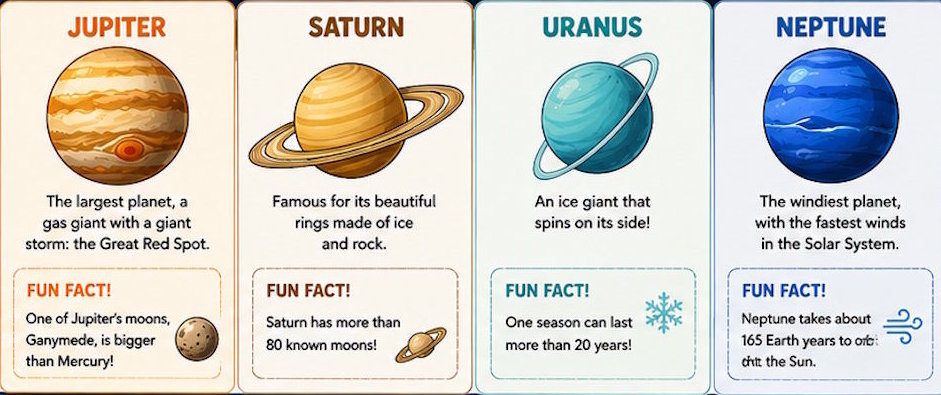
Jupiter
Jupiter is the largest planet in the Solar System. It is a gas giant made mostly of hydrogen and helium.
Jupiter is famous for its enormous Great Red Spot, a gigantic storm that has been observed for centuries.
The planet also has a large family of moons. Four of the most famous are Io, Europa, Ganymede, and Callisto.
Fun fact: Ganymede, one of Jupiter’s moons, is larger than the planet Mercury.
Saturn
Saturn is the second-largest planet and is famous for its spectacular system of rings.
The rings are made mainly of countless pieces of ice and rock. Although Saturn’s rings look like a single solid structure from far away, they are actually made up of many individual particles.
Saturn has many moons, including Titan, a fascinating world with a thick atmosphere and lakes and seas of liquid hydrocarbons on its surface.
Uranus
Uranus is an ice giant located far from the Sun. It has a blue-green color caused by methane in its atmosphere.
Uranus is unusual because it rotates almost on its side. Scientists think a gigantic collision long ago may have caused this strange tilt.
Fun fact: One season on Uranus can last for more than 20 Earth years.
Neptune
Neptune is the eighth and most distant planet from the Sun.
It is another ice giant and has a deep blue appearance. Neptune is famous for having some of the fastest winds in the Solar System.
Because it is so far from the Sun, Neptune takes about 165 Earth years to complete one orbit.
🌙 Moons: Worlds That Orbit Planets
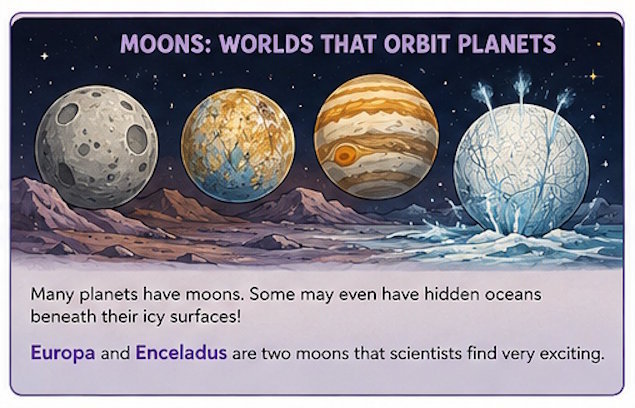
Planets aren’t the only interesting worlds in the Solar System. Many planets have moons, also called natural satellites.
Some moons are small and covered with craters, while others are surprisingly complex worlds of their own.
Earth has one Moon. Jupiter and Saturn have dozens of known moons, including some of the most fascinating objects in the Solar System.
Some moons may even have underground oceans of liquid water hidden beneath layers of ice. Scientists are particularly interested in moons such as Europa and Enceladus because they may have conditions that could potentially support life.
☄️ Asteroids and Comets
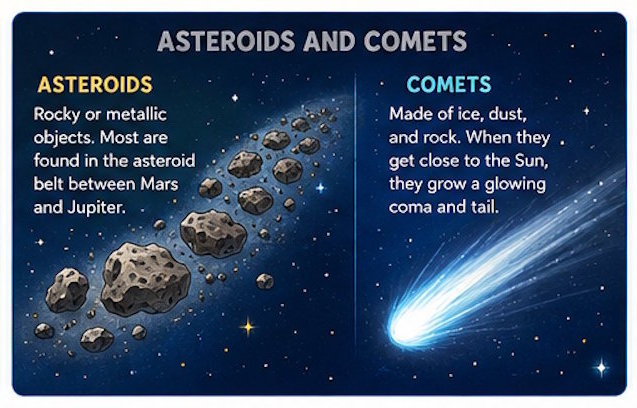
The Solar System also contains millions of smaller objects.
Asteroids are mostly rocky or metallic objects. Many orbit the Sun in the asteroid belt, a region located between Mars and Jupiter.
Comets are made largely of ice, dust, and rocky material. When a comet travels close enough to the Sun, heat can cause some of its icy material to turn into gas. This can create a glowing coma and a spectacular tail.
Despite their appearance, comet tails do not always point behind the comet as it moves. They are pushed away from the Sun by sunlight and the solar wind.
🪐 What About Pluto?
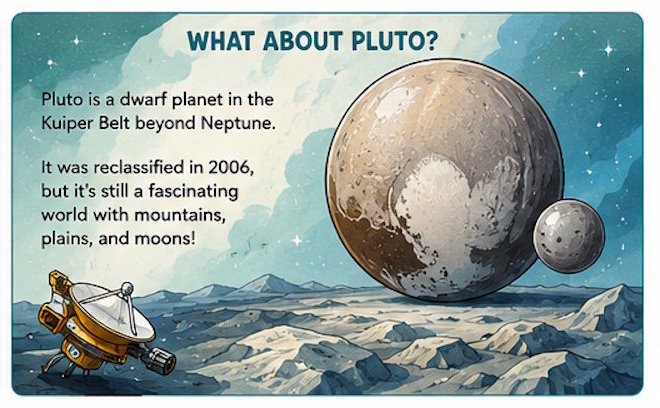
You may remember learning that Pluto was the ninth planet. Today, Pluto is classified as a dwarf planet.
Pluto is located in a distant region called the Kuiper Belt, beyond Neptune’s orbit. It is a fascinating icy world with mountains, plains, and several moons.
Pluto was reclassified as a dwarf planet in 2006 because scientists developed a more precise definition of what counts as a planet.
Pluto may no longer be one of the eight planets, but it is still an important and fascinating member of our Solar System.
🚀 A Giant Cosmic Neighborhood
The Solar System is enormous. Even traveling at the speed of light, it would take hours to cross from the Sun to the outer planets.
And the Solar System is only a tiny part of the universe.
Our Sun is one star among hundreds of billions in the Milky Way galaxy. The Milky Way itself is just one of an enormous number of galaxies in the observable universe.
So when you look at the night sky, you are not simply looking at a collection of little lights. You are looking into an unimaginably large universe filled with stars, planets, moons, galaxies, and countless mysteries still waiting to be explored.
⭐ Quick Solar System Facts
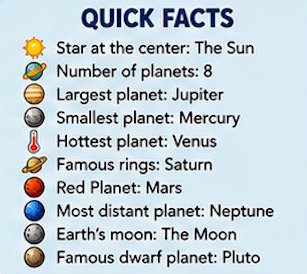
- Star: The Sun
- Number of planets: 8
- Largest planet: Jupiter
- Smallest planet: Mercury
- Hottest planet: Venus
- Planet famous for its rings: Saturn
- Red Planet: Mars
- Most distant planet: Neptune
- Earth’s natural satellite: The Moon
- Famous dwarf planet: Pluto
🌌 Keep Exploring!
The Solar System is a wonderful place to begin learning about space. Every planet is different, every moon has its own story, and new discoveries continue to change what we know about our cosmic neighborhood.
So the next time you look at the Moon, spot a bright planet, or see the stars above you, remember: you are looking at just a small part of an enormous universe.
There is always more to discover!
FREE DESKTOP WALLPAPER
Click the image, save it, and use it as your desktop wallpaper 🙂
LEARN MORE:
Solar_System on Wikipedia…
Solar System’s Images on Google…
Solar System’s Videos on YouTube:
Related keywords: Solar System for Kids, planets for kids, space for kids, astronomy for children, Sun, Mercury, Venus, Earth, Mars, Jupiter, Saturn, Uranus, Neptune






Add comment